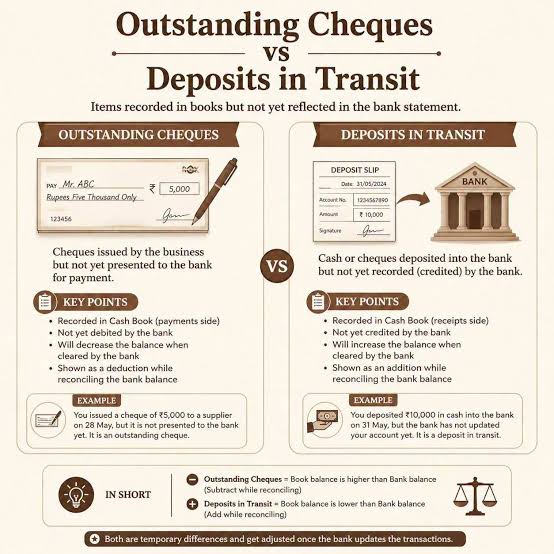
Outstanding checks are a common reason why a business’s accounting records may not match its bank statement. When a check has been recorded in the bookkeeping system but has not yet been presented to or cleared by the bank, it is considered an outstanding check.
Understanding how to handle outstanding checks during bank reconciliation is important for maintaining accurate financial records and understanding your business’s actual cash position. While an outstanding check is not necessarily a bookkeeping error, it must be properly identified and tracked during the reconciliation process.
In this guide, we explain what outstanding checks are, why they occur, how to account for them during bank reconciliation, and what to do when a check remains outstanding for an extended period.
What Is an Outstanding Check?
An outstanding check is a check that has been issued and recorded in a business’s accounting records but has not yet cleared the bank.
For example, suppose your business writes a $1,000 check to a supplier on March 28. You record the payment in your bookkeeping system on that date. However, the supplier does not deposit the check until April 3.
Your accounting records will show the $1,000 payment in March, while the bank statement will not show the withdrawal until April. This creates a temporary difference between the two records.
This difference is known as an outstanding check.
Why Do Outstanding Checks Affect Bank Reconciliation?
Bank reconciliation involves comparing your accounting records with your bank statement. Because checks can take time to clear, the bank balance and book balance may temporarily differ.
When a check is outstanding, the payment has already been recorded in the accounting records but has not yet been deducted from the bank account.
As a result, the bank statement balance may be higher than the balance shown in your bookkeeping system.
Outstanding checks are therefore considered a timing difference rather than an error, provided the transaction has been recorded correctly.
How to Identify Outstanding Checks
Identifying outstanding checks is an important part of the bank reconciliation process.
Start by comparing the checks recorded in your accounting system with the checks that have cleared on your bank statement.
Look for checks that:
- Are recorded in your books
- Have not appeared on the bank statement
- Have not been cancelled or reversed
- Were legitimately issued to a supplier, employee, or other recipient
You should also review the check number, date, amount, and payee to make sure the transaction is correctly recorded.
If a check appears in your bookkeeping records but does not appear on the bank statement, it may be an outstanding check.
How to Handle Outstanding Checks During Bank Reconciliation
Step 1: Verify the Check Was Issued
Before treating a check as outstanding, confirm that it was actually issued.
Review your check register, accounting records, payment documentation, or other supporting records.
If the check was never issued, the bookkeeping entry may need to be corrected rather than treated as an outstanding item.
Step 2: Check the Bank Statement
Review the current bank statement and recent statements to determine whether the check has cleared.
Sometimes a check may have cleared after the statement period ended. In this case, it may appear on the next bank statement.
Step 3: Confirm the Check Details
Compare the check number, date, payee, and amount with your accounting records.
An incorrect check number or amount can make it difficult to match the transaction when performing bank reconciliation.
Correct any bookkeeping errors you discover.
Step 4: List the Check as a Reconciling Item
If the check has been correctly recorded but has not cleared the bank, list it as an outstanding check on your bank reconciliation.
You generally do not need to create another bookkeeping entry simply because the check has not cleared.
Instead, document the outstanding check and account for the difference when reconciling the bank statement.
Step 5: Monitor the Check
Continue monitoring outstanding checks during future bank reconciliations.
Once the check clears the bank, it should appear on the bank statement and no longer be listed as an outstanding reconciling item.
Example of an Outstanding Check
Consider a business with a book balance of $15,000 and a bank statement balance of $17,000.
During reconciliation, the business discovers a $2,000 check that was issued to a supplier but has not yet cleared.
The accounting records already reflect the $2,000 payment, but the bank has not deducted the amount.
The $2,000 outstanding check explains the difference between the two balances.
Once the check clears the bank, the bank statement balance will decrease by $2,000, assuming there are no other reconciling items.
What If an Outstanding Check Is Very Old?
An outstanding check should not necessarily remain on your reconciliation indefinitely.
If a check remains outstanding for an unusually long period, investigate why it has not been deposited or cleared.
Possible reasons include:
- The recipient has not deposited the check
- The check was lost
- The payment was cancelled
- The recipient no longer needs the payment
- The check was replaced
- The check was entered incorrectly
- The check has become stale under applicable banking rules
Contact the relevant recipient where appropriate and determine whether the payment is still valid.
Do not simply remove an old outstanding check without understanding what happened to the underlying payment.
How to Correct an Old Outstanding Check
If you determine that an outstanding check is no longer valid, the appropriate accounting treatment depends on the circumstances and your accounting procedures.
For example, if a check was cancelled and a new payment was issued, the original transaction may need to be reversed or otherwise adjusted in the accounting records.
If the recipient still needs to be paid, a replacement payment may need to be arranged.
Because the correct treatment can depend on the circumstances and applicable accounting or tax requirements, businesses should consider consulting their accountant or bookkeeper when dealing with significant or long-outstanding checks.
Common Mistakes When Handling Outstanding Checks
One common mistake is treating every unreconciled check as an accounting error. An outstanding check can simply be a normal timing difference.
Another mistake is deleting an outstanding check just because it has not cleared. Doing so can cause your bookkeeping records to become inaccurate.
Businesses should also avoid creating duplicate transactions when a check eventually clears. The original payment should be matched to the cleared bank transaction rather than recorded as a new expense.
Finally, failing to review old outstanding checks can cause reconciliation problems and make it difficult to determine the true status of unpaid obligations.
Best Practices for Managing Outstanding Checks
Good bookkeeping procedures can make outstanding checks easier to manage.
Consider these practices:
- Maintain an accurate check register.
- Reconcile bank accounts regularly.
- Record checks promptly.
- Review outstanding checks during each reconciliation.
- Investigate checks that remain outstanding for extended periods.
- Keep supporting payment documentation.
- Avoid duplicate entries when checks clear.
- Communicate with recipients when necessary.
- Keep a clear audit trail for corrections and adjustments.
Accounting software can also help track outstanding transactions and match cleared payments with bank activity.
Final Thoughts
Knowing how to handle outstanding checks during bank reconciliation is an important part of accurate bookkeeping. Outstanding checks are usually timing differences rather than errors, but they need to be identified, documented, and monitored.
During each bank reconciliation, compare your check records with the bank statement and identify checks that have been issued but have not yet cleared. Verify that each check is legitimate and correctly recorded, then list it as a reconciling item until it clears.
If a check remains outstanding for an unusually long time, investigate the reason before making any adjustment. Properly managing outstanding checks helps keep your accounting records accurate and gives you a clearer understanding of your business’s cash position.